Monday, 12 March 2012

Presépio in the International Almere Site


The post "My A-Z of the Netherlands: A is for Almere" was published in the  International Almere site!

Thank you Connie for the invitation and to you too, Sonja, for all the support you gave me with the post!

If you are coming to The Netherlands, more precisely to Almere, please, take a look at IA's site! You will find very useful information about Expat Life and Integration in Dutch Society!

I will be there sometimes!

Here the interview that Connie gave to Presépio about International Almere in December 2010!

By the way, International Almere is celebrating its second anniversary! Congratulations IA!


Have Fun!

Sunday, 11 March 2012

Flying Swans


Two swans flying along the canal! What a great moment I had today! My camera was in my pocket, so I couldn't take a photo. I was walking with my hubby, enjoying the sunshine and then, that great moment, like a gift, an unexpected gift!

I've never seen something like this before! Lindo!! :-)


From A-Z

From A-Z

Tuesday, 6 March 2012

Prague: A Romantic Jewel


Prague opens for us enchanted doors ....

From Prague Doors

From Prague Doors

From Prague Doors

From Prague 2012

and invites us to roam on its very well preserved historic streets full of lovely details ...

From Prague 2012

giving us the key to discover a kingdom of...

From Prague 2012

romance ...

From Prague 2012

adventure...

From Prague 2012

faith...

From Prague 2012

courage...

From Prague 2012

strong beliefs...

From Prague 2012

innocence...

From Prague 2012

music...

From Prague 2012

art...

From Prague 2012

glamour...

fun...

From Prague 2012
fantasy...

From Prague 2012

dreams...

From Prague 2012
wonder...

From Prague 2012
the best time of your life...

From Prague 2012
and the secret wish...

From Prague 2012

to come back again very soon... ;-)

From Prague 2012

Friday, 2 March 2012

My A-Z of The Netherlands: C is for Children


On 14 February 2007, the United Nations considered the Dutch children the happiest in the world. On December of the same year I arrived in the Netherlands. Let me share with you my first impressions on Dutch children.

1. MANY, MANY CHILDREN  in Almere

Mothers with two, three and sometimes four children by their hands. Absolutely fantastic! In the last two decades, I never saw so many children as here! It's amazing!


From Almere (III)

I used to live in Lisbon, a very beautiful city, but where the population is very old. Most of the young and middle age people working there are living in smaller cities nearby, where it is cheaper to buy an apartment. 
According to this study, in 2005, Lisbon was the portuguese city with the oldest population, and the European capital with the largest ratio of older people (134.000 per 564.000 inhabitants). As you can imagine, I was not used to see many children in the streets during the day. Unfortunately, the lack of children is not only a problem in Lisbon. Last month, the President of the Portuguese Demography Association, stated that Portuguese population is one of the eldest in the world. In 2007, 2009 and 2010 the number of births was lower than the number of deaths. Nowadays, most Portuguese couples have only one child.

2. DUTCH PARENTS ARE MORE RELAXED WITH THEIR CHILDREN

According to my experience in Portugal, my generation, in general matters, is very anxious with their children. These are overprotected in my point of view.
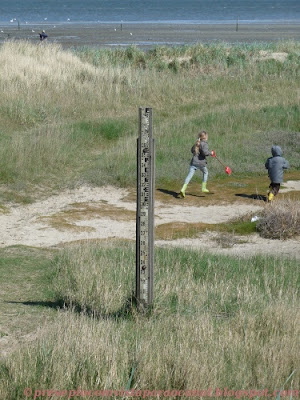
Here I find the parents careful enough, giving their children the opportunity to experience small adventures and solve their own small problems. A light injury is not seen as "a great disaster".

From Katwijk aan Zee

From Texel

3. CHILDREN PLAY IN THE STREETS WITHOUT ADULT SUPERVISION 

In my street, there are a couple of playgrounds for the children. Sometimes, there is an adult nearby, but most of the times, the children are playing together in small groups without an adult supervision. However, I perfectly understand that in Portugal probably we have more reasons to fear for our children's safety than in The Netherlands. Besides, Dutch mommies can always peek through the windows of their kitchens or stay in the front garden watching them.

4. MORE CHILDREN IN PUBLIC GARDENS 

Well, I see more people in public gardens in general than in my country, at least when I was still living there. 

From A-Z

In the last 15 years, I realized that most of the Portuguese families spend their Sunday afternoons in shopping malls. I remember to find this very depressing! However, there was a park in Lisbon where I used to find many children: Parque da Serafina in Monsanto. 
In The Netherlands, I see more children playing outside which I think it's much healthier. The Dutch appreciate very much outdoor activities and besides there aren't many shopping malls here as in Portugal. 
Lucky me when I was a child! No shopping mall and no playstation! My grandpa used to take me for long walks in the woods or to pick up figs and blackberries. I used to play in the street and went a lot to the park to have picnics, like the Dutch still do.

From Texel

5. MORE BIRTHDAY PARTIES AT HOME

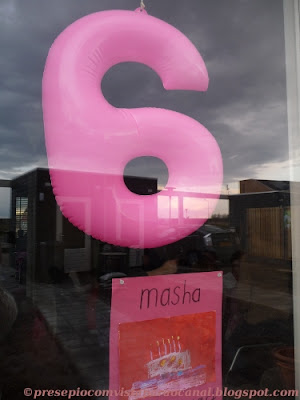
I see that by the front door decorations. I used to have birthday parties at home too. However, in Portugal, this tradition has changed. In the last 15 years, most of the children celebrate their birthdays at the malls or in rented indoor playgrounds. I don't like it, specially because of the lack of fresh air and the noise, always worse in a closed place. I also found myself thinking several times, that they are growing up without homely birthday memories. Sad, in my opinion...

From Pasen 2010

6. DUTCH BIRTHDAY PARTIES ARE MORE FRUGAL

On a Dutch table, we will find coffee, tea, juices, some snacks, birthday cake and sometimes pancakes. The most important, as far as I realized, is to be together with family and friends to celebrate the child's birthday. And if we think about it, that is what really matters.
However, I find the Portuguese traditions very lovely too. I have great memories of my birthday table full of different sandwiches, several cakes, puddings, mousses, jellies, arroz-doce, and Sumol, of course. Do you remember the Sumol green bottles? :-)


After my father's death and the economical crisis that Portugal faced in the end of the seventies and in the beginning of the eighties (IMF was there as it is today),  my mother couldn't afford big birthday parties as before. In those difficult times, I used to celebrate only with the family. If I was a Dutch child, I would have my big party, with many  friends and neighbours, in the same way. A lot of food on the table is not so important here as it is in Portugal. Only the juices, the birthday cake and some pancakes would be enough! No one would complain about my birthday party being "very poor"(you know what I'm talking about...).
.
7. CHILDREN GO TO SLEEP VERY EARLY, AT 7.00 OR 7.30 PM 

According to my experience, in Portugal, the children go to sleep at 9.00/ 9.30 pm.
I used to go to bed at 11 pm when I was child ;-))) My father had a restaurant, so I stayed more or less awake to see him in the evening. I remember to watch José Corte-Real on TV and then listening to the national anthem at the end of the daily broadcast.

8. CHILDBIRTH: HOME BIRTHS, MIDWIFES, ANAESTHETICS AND KRAAMZORG 

The Netherlands has a HIGH RATE OF HOME BIRTHS compared to other countries.
In 2010, 184 thousand children were born in the Netherlands. 

Three quarters were hospital births, one quarter home births. Most of them are attended by MIDWIFES. Early 2010, more than 2.5 thousand midwives were active in the Netherlands.

"Most midwives in the Netherlands work in primary care where they are the lead professionals providing care to women with 'normal' or uncomplicated pregnancies. They are independent practitioners, like general practitioners or family doctors, and work in single-handed, duo-, or group-practices. In case of complications or an increased risk of complications during pregnancy, during labour or in the postpartum period, the midwife will refer her client to secondary care, where a gynaecologist will take over responsibility. The indications for referral have been agreed upon by all professional groups involved (gynaecologists, midwives and general practitioners) and are laid down in the so-called Obstetric Indication List [2]." (http://www.biomedcentral.com/)

ONLY 10% of Dutch women (2009) use ANAESTHETICS in their labors.

"The rate of epidural use in the Netherlands is low and there is an absence of anaesthetists available out of ‘normal’ hours so do your homework to find out which hospitals can honour your request for pain relief." advise Amanda van Mullingen in Expatica.

The Netherlands has the worst scores in Europe related to childbirth rates according to the PERISTAT-II STUDY:

"In Peristat-II from 22 weeks gestation, after France, The Netherlands had the highest fetal mortality rate (7.0 per 1,000 total number of births). Of all western European countries, The Netherlands had the highest early neonatal mortality rate (3.0 per 1,000 live births). Over the past 5 years the perinatal mortality rate in The Netherlands has dropped from 10.9 to 10.0 per 1,000 total births but this drop has been faster in other countries."
Take a look at this post for further information.

KRAAMZORG is probably the main positive aspect of giving birth in The Netherlands.
We are talking about a week of postnatal care at home which includes caring for the mother and the baby, light household duties and guidance on breast feeding.

9. DUTH MOTHERS HAVE PART-TIME JOBS

Less than 10% of Dutch women work full-time. In Portugal, it's very difficult to work in part-time, except in call-centers. My friends are always exausted. They complain a lot about spending so little time with their children. They arrive (tired) at home around 8 p.m. and barely have the time to diner and put the children to sleep. In the Netherlands, the families  enjoy their time together in a more relaxed way. I don't notice either any prejudice against staying- at-home moms as I have noticed in Portugal. Also the fathers enjoy more time with
their children because of the weekly day they spend at home with them, the "famous" Papadag.

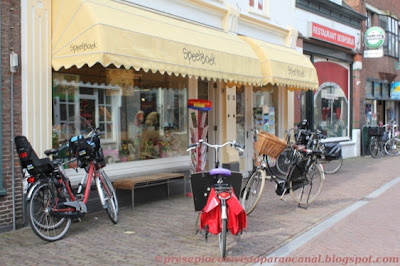
From Amersfoort
This photo was taken in the morning, a year ago, in front of a children's bookstore in Amersfoort. You can see a couple of mom's bikes very well prepared to carry their children on.

10. CHILDCARE IS VERY EXPENSIVE 

Take a look at this Teresa 's post. In this childcare center, for example, a day per week costs €284 per month, and five days per week about €1420. Are you still there? ;-)) Most of the children are in childcare on a part-time basis.You can know more about the Dutch Childcare System and the Childcare Allowances by reading this Expatica article.

11.THE EDUCATION COSTS  

Take a look at this  experience of a Portuguese mother living in Groningen.

If you are a mom in The Netherlands and you want to share your experience with us, please do. You are very welcome!
For those who are thinking about leaving their home country, I strongly advise you to get all the information you can about your future host country before your departure, specially if you have children or intend to get pregnant. Expat life is emotionally very demanding, even more with kids.


Monday, 27 February 2012

Never Tear Us Apart

This video will tell you where I was for the last 5 days... ;-)


 See you soon!

Tuesday, 14 February 2012

At The Weerwater Lake


Last Sunday. At the Weerwater Lake.

From Coisas Minhas II


From Coisas Minhas II


Just Like Heaven (The Cure)

You, soft and only
You, lost and lonely 
You, strange as angels 
Dancing in the deepest oceans 
Twisting in the water 
You're just like a dream 
You're just like a dream

Friday, 10 February 2012

My A-Z of the Netherlands: B is for Bikes


When we think about The Netherlands, we think about bikes and cycling paths. It's one of the country's trademarks. This interesting video tells us how cycling became so common in The Netherlands almost 40 years ago.


I don't cycle like the Dutch do

I don't cycle when it's snowing, windy, rainy or cold. I generally take the bus. Almere has a very good bus network. The bus stop is just around the corner and every 7 minutes we have a bus to the city center. A much warmer and comfortable trip, don't you think? ;-)
I only use my bike for recreation purposes. I enjoy cycling, specially in the spring, nearby the canal. I stop here and there, have a picnic, watch the sunset, and come back. Heel leuk!
For the rest, I use the bus or the train. I don't need to use my bike as they show in the video below. However, I think it is very cool to do as they do it!


I don't have a long history with bikes

I had a bike when I was a child, but soon I stopped cycling. The primary school, as well as the high school, were just around the corner. Later, when I went to the University, the bus and the metro were my favourite means of transport. And they remain so for 20 years more.
My current bike was bought after two years living in The Netherlands. I didn't miss it at first because we were living in the city center. Everything was just there.

A sad episode

One day, I dared to go for a long ride and I even crossed a bridge. However, the experience didn't go so well. I was on the right side of the road when I saw that a motorbike was coming on the left side. So far, so good. I slowed down a bit. Then, another motorbike suddenly appears between me and the previous one and I saw myself with no space available to go forward. I was not expecting this and I got scared and fell. Nobody stopped or asked me if I was ok. Just for luck, my glasses didn't drop in the canal. Niet leuk! Now, I'm trying other routes. I have a lot of paths to discover yet.

The Dutch are Pros with their bikes

The Dutch are very professional when riding their bikes. I'm far from having their cycling confidence.
I don't see myself riding my bike and, at the same time, reading a sms, talking on the phone, reading a newspaper or holding an umbrella. For me, it's also difficult to stop at the stoplight, put the foot in the floor and then restart cycling. I need a sidewalk where I can lean on.

Everyday Life in a Bike


In this video, you will find very interesting moments, specially in the following minutes:

1.42  A lady riding a bike and watching her mobile phone.

2.20  A lady riding her bike with her bags behind and her child in the front.

5.09  A lady riding her bike with one child behind and another in the front.

5.28  A lady riding her bike with a front box and three children inside.

6.18  A lady riding a brommer, very useful for those who have problems with their legs or get tired easily.

7.53  Children, adults and old people cycling. This is Netherlands!!!

8.29  A housewife in her bike with several baskets.

8.34  A well dressed lady riding her bike, probably coming from her work.

Almere has an extensive cycling network

Almere offers great cycling conditions. An extensive network of free cycling paths covers the entire city. Bikes can be rented at Almere Centrum and Buiten train stations. The Spoorbaanpad in Almere is considered the longest urban cycle route of the country. The name means ‘Rail road path’ and refers to the fact that it follows the rail road for its entire length. For more details, please click here.


How we say "bike" in Dutch?

"Fiets"! You can't imagine my surprise when I've heard it for the first time. "That's so different!" I thought...

I would like to hear from you about your cycling experience in The Netherlands. Do you want to share it with us?